DNV’s latest Energy Transition Outlook reveals a pivotal moment in climate action yet warns the path to 1.5°C is slipping away. What does this mean for our clean energy future?
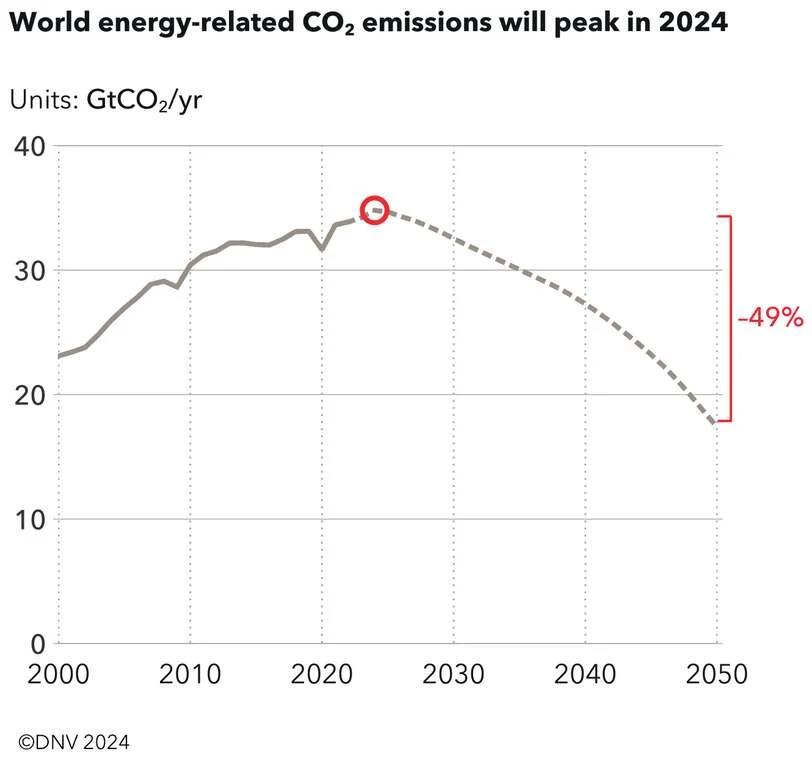
The global fight against climate change has reached a pivotal moment. According to DNV’s latest Energy Transition Outlook, 2024 is poised to become a watershed year – the first time in modern history when global emissions are expected to peak and begin their long-awaited decline.
This milestone, unthinkable just a few years ago, marks the true beginning of the world’s energy transition. However, as the report reveals, this turning point comes with a stark warning: despite this progress, the path to achieving net zero emissions by 2050 remains fraught with challenges.
DNV, a global quality assurance and risk management company, has been at the forefront of analysing energy trends for close to 155 years. Its latest report, drawing on the expertise of more than 100 internal and external specialists, provides a comprehensive forecast of the global energy landscape up to 2050.
The good news is evident: emissions are expected to decline from next year onwards for the first time since the Industrial Revolution. DNV projects that 2050 emissions will have almost halved from current levels. This decline is primarily driven by the rapid growth of renewable energy sources, particularly solar and wind power, coupled with the increasing adoption of electric vehicles.
Solar power, in particular, has seen explosive growth. In 2023 alone, new solar installations surged by an impressive 80%, reaching 400 GW globally. This growth is further accelerated by plummeting battery prices, which fell by 14% last year. These technological advancements are making round-the-clock solar power increasingly accessible and affordable.
According to DNV, the electric vehicle (EV) market is another bright spot. EV sales increased by 50% last year, putting the world on track to achieve DNV’s long-standing prediction that half of all new passenger vehicle sales will be electric by 2031. This shift is already impacting petroleum demand, particularly in China, where record EV sales are beginning to curb oil consumption.
However, the report also highlights significant challenges. Despite the positive trends, the current pace of transition needs to catch up to what’s required to meet the Paris Agreement targets. DNV forecasts that the planet will warm by 2.2C by the end of the century, well above the 1.5C goal.
The energy mix is evolving, but not rapidly enough. While today’s mix is roughly 80% fossil fuels and 20% non-fossil, by 2050, it’s projected to be split equally between the two. Renewables are expected to grow 2.2 times from now to 2030, which, while impressive, still lags behind the COP28 goal of tripling renewable energy capacity.
Moreover, the transition faces hurdles in hard-to-abate sectors. Technologies like carbon capture and storage (CCS) and hydrogen production struggle to gain traction. DNV has revised its forecast for hydrogen and its derivatives by 20% since last year, expecting them to account for only 4% of final energy demand in 2050.
Similarly, while slightly more optimistic about CCS, the report predicts that only 2% of global emissions will be captured by this technology in 2040, rising to just 6% by 2050. Geopolitical factors also play a role in shaping the energy transition. Despite being the world’s largest CO2 emitter, China is leading in clean tech deployment. Last year, it accounted for 58% of global solar installations and 63% of new EV purchases.
However, this dominance sparks concerns and potential trade barriers in other countries. Furthermore, global events are impacting the transition. Many nations are diverting budgets towards military spending, reducing funds available for clean energy initiatives. High borrowing costs and ongoing cost-of-living crises in many households are also slowing progress.
Remi Eriksen, DNV’s Group President and CEO emphasises the significance of this moment: “2024 is the year that the global energy transition has begun; it is also the year that emissions are likely to peak.” However, he stresses that the focus must shift to how quickly emissions decline, as the current trajectory falls far short of Paris Agreement targets.
While the peak in global emissions marks a historic achievement, it’s clear that much more needs to be done. Accelerating the deployment of renewable energy, overcoming challenges in hard-to-abate sectors, and fostering international cooperation will be critical in the years ahead.
The energy transition has begun, but the race to net zero is far from over.